The Best Hiking Baby Carriers: Three Frame Packs, Weighed Against the 48.5-Pound Limit
Three framed child carriers compared on pack weight, torso range and the federal frame-carrier standard, plus the recall codes to check on a used one.
- Editor, gear and the arithmetic of a small home
- Oct 9, 2026
- 14 min read
3 products compared
In this guide
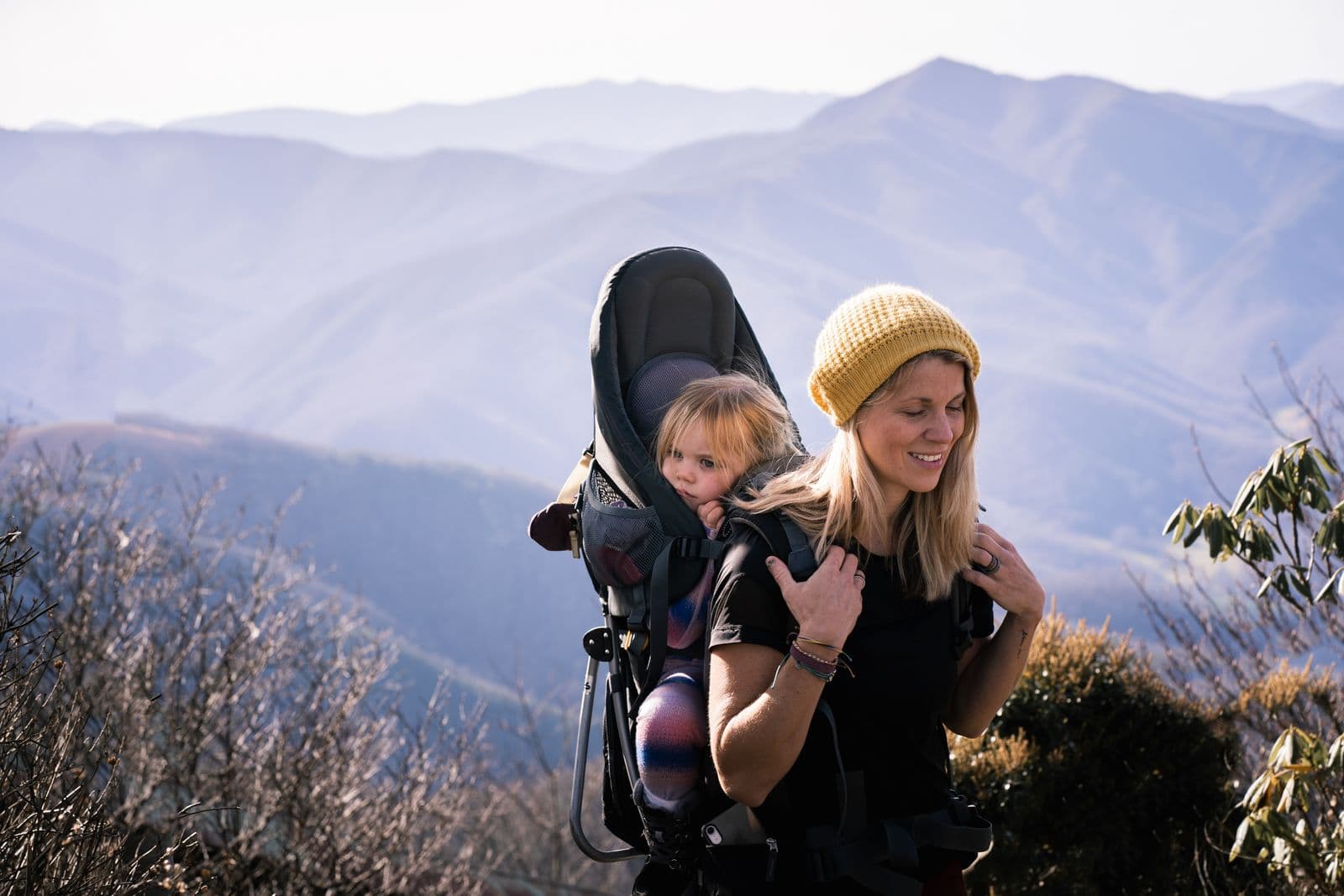
A framed hiking carrier is the only baby carrier that is also a rucksack. It has an aluminum frame, a padded hipbelt, a harnessed seat that rides on your back, and a federal standard of its own. It is also the one format that fails a buyer in the opposite way to every other carrier. A soft carrier is usually outgrown. A frame pack is usually bought too early, used three times on flat paths, and then stored in a closet because it weighs as much as a small child before anyone is in it.
The useful number for this category is the same on all three packs below: 48.5 pounds. That is the maximum overall load Osprey, Thule and Kelty each publish, and on every one of them it counts the child, the gear and the pack itself together. So the pack's own weight is not a comfort detail. It is weight subtracted from what the child and the water bottles can be, and the spread across these three is almost three pounds.
What actually decides this
Whether your child can sit upright without help. Every manufacturer here sets the start point by ability, not by a birthday. Osprey's Poco LT manual says not to use the carrier with a child less than six months old, under 16 pounds, or who "cannot sit upright unassisted." Thule says a child can use the Sapling "once they can sit upright unaided, typically around six months of age." Deuter, whose carriers are not carded here for reasons covered below, puts it later, saying independent sitting with good head control "usually starts at eight/nine months." The AAP, writing on HealthyChildren.org, adds that infants born prematurely or with respiratory problems should not go in backpacks or other upright positioning devices at all. The age printed on a box is a floor, and the child's own trunk control is the real start date.
The 40-pound child ceiling, and the 48.5-pound total. Osprey, Thule and Kelty all cap the child at 40 pounds and the whole load at 48.5. A 35-pound child in an 8.4-pound pack leaves about five pounds for everything else. That is a litre of water, a jacket and the diaper kit, and not much more.
Torso range before anything else about fit. A frame pack carries well only when the hipbelt sits on the hip bones and the frame length matches your back. Osprey publishes a 15 to 21 inch torso range and a 28 to 50 inch hipbelt on the Poco LT. Kelty lists 15.5 to 21 inches on the Journey PerfectFIT. Thule says the Sapling has a "fully adjustable torso and hip belt" but does not print the range on its product page. If two adults of very different heights will share one pack, measure both torsos first. The approach is the same one laid out for front carriers in carrier fit for petite and plus-size parents.
Sun cover is not standard. Osprey includes a sunshade with the Poco LT, and its 5.56-pound weight is quoted with the sunshade fitted. Thule includes a deployable UPF 50 sunshade on the Sapling. Kelty's product page for the Journey PerfectFIT says plainly: "Sunshade Included: No," and that the shade is sold separately. The AAP's HealthyChildren page calls a sunshade "a good idea" on a backpack carrier, and a child riding above your shoulders has nothing between them and the sky.
The standard every frame pack is sold under
Frame child carriers have their own federal rule. 16 CFR Part 1230 is the CPSC's "consumer product safety standard for frame child carriers," and its single requirement is that every frame child carrier "must comply with all applicable provisions of ASTM F2549-22," the voluntary standard approved on April 1, 2022 and incorporated by reference in September 2022. Osprey's current Poco LT manual states the pack is "tested in accordance with EN 13209-1:2022 & ASTM F2549-22," which is the European and the American standard at once.
What the standard is built around shows up in the warnings it produces. The first warning in the Osprey manual is "FALL HAZARD: Your child can slip through leg opening or fall out of product and suffer a serious head injury." That is not a hypothetical. In 2017 the CPSC announced a recall of about 82,000 Osprey Poco, Poco Plus and Poco Premium carriers made between January 2012 and December 2014 because "a child seated in the carrier can slip through the leg openings." Osprey had four reports of children falling through, one with a skull fracture, and the remedy was a seat pad insert. That recall covers packs more than a decade old and not the current Poco LT, but it is exactly why a frame pack's leg openings and harness are the first thing to check on any used one.
The picks
$339.95
Price checked Oct 9, 2026
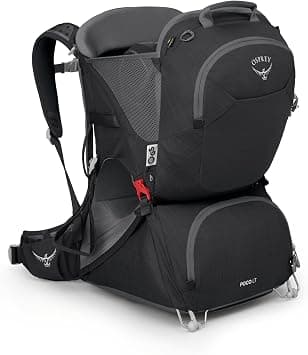
Osprey Poco LT
At 5.56 pounds with its sunshade fitted, the Poco LT leaves the most of the 48.5-pound limit for the child and the gear. Osprey publishes the fit numbers in full, a 15 to 21 inch torso range and a 28 to 50 inch hipbelt, so two very different adults can check before buying rather than after. The frame folds flat to 6.5 inches deep for the car trunk. It is wrong for anyone planning long, steep days with a heavy child, because the lighter build is the trade Osprey made for travel, city walks and shorter trails.
We may earn a commission on this link. It never changes the ranking.
- Pack weight
- 5.56 lb with sunshade
- Child weight
- 16 to 40 lb, 6 months+, sits unassisted
- Max total load
- 48.5 lb
- Torso / hipbelt
- 15 to 21 in / 28 to 50 in
- Storage
- 25 L
What works
- 5.56 lb with the sunshade included, the lightest of the three
- 28 to 50 inch hipbelt and 15 to 21 inch torso range, both published
- Built-in sunshade and adjustable stirrups for children near the top of the range
- Folds to 29.5 x 14 x 6.5 inches
What to know
- Lighter frame and suspension than the Thule for long days at the 40 lb end
- 25 L of storage is generous for a light pack but it is not a full hiking pack
- The most expensive of the two lighter packs by $40
$299.95
Price checked Oct 9, 2026
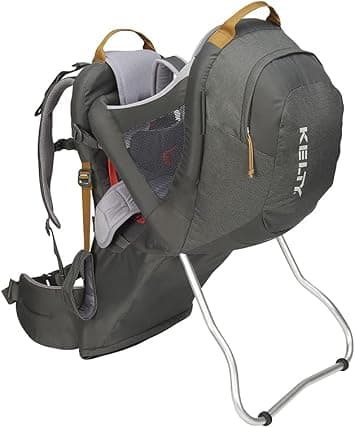
Kelty Journey PerfectFIT
The Journey PerfectFIT is the cheapest pack here and gives up surprisingly little for it: an aluminum frame, a five-point harness, a padded aluminum roll cage around the child's head, and a 15.5 to 21 inch torso range. At 6 lb 6 oz it sits between the Osprey and the Thule on weight. The catch is printed on Kelty's own page: the sunshade is sold separately. A buyer hiking in open country should budget for it or choose a pack that ships with one.
We may earn a commission on this link. It never changes the ranking.
- Pack weight
- 6 lb 6 oz
- Child weight
- 16 to 40 lb
- Max total load
- 48.5 lb
- Torso range
- 15.5 to 21 in
- Storage
- 17 L
- Sunshade
- Not included
What works
- $299.95, the same price on Amazon as on Kelty's own store
- Five-point harness and padded aluminum roll cage
- 15.5 to 21 inch torso range
- Holds the same 16 to 40 lb child range as the dearer packs
What to know
- No sunshade included on this base model
- 17 L of storage, the least of the three
- Kelty does not publish a hipbelt range on the product page
$399.95
Price checked Oct 9, 2026
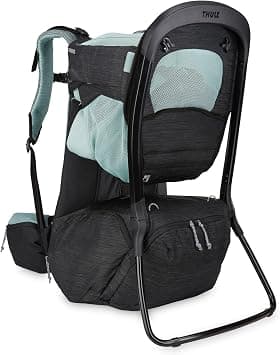
Thule Sapling
The Sapling is the heaviest and most expensive pack here, and it is built for the person who will actually spend a whole day on a trail. It carries a 22 L gear compartment reachable through side zippers while the pack is on, a deployable UPF 50 sunshade, and Thule's ErgoRide seat, which supports the child under the legs rather than relying on foot stirrups. The seat comes out and goes in the washing machine. It is wrong for anyone who mainly needs a pack for errands and short walks, because 8.4 pounds of frame is 2.8 pounds more than the Osprey on every outing.
We may earn a commission on this link. It never changes the ranking.
- Pack weight
- 8.4 lb
- Child weight
- Up to 40 lb, sits upright unaided
- Max total load
- 48.5 lb
- Storage
- 22 L
- Sunshade
- UPF 50, included
What works
- 22 L gear compartment, the largest here, with side-zip access
- Deployable UPF 50 sunshade included
- ErgoRide seat supports under the child's legs with no stirrups to adjust
- Removable, machine-washable seat
What to know
- 8.4 lb, which leaves the least of the 48.5 lb limit for child and gear
- $399.95, the most expensive by $60
- Thule does not print a torso range on its product page
The comparison, in one table
| Pack | Price | Pack weight | Child range | Storage | Sunshade |
|---|---|---|---|---|---|
| Osprey Poco LT | $339.95 | 5.56 lb | 16 to 40 lb | 25 L | Included |
| Kelty Journey PerfectFIT | $299.95 | 6 lb 6 oz | 16 to 40 lb | 17 L | Not included |
| Thule Sapling | $399.95 | 8.4 lb | Up to 40 lb | 22 L | UPF 50, included |
Who each one is wrong for
The Osprey Poco LT is wrong for a family whose idea of a hike is six hours and a summit with a three-year-old near the 40-pound line. That is the job the heavier suspension of the Sapling was built for. It is right for travel, city walking and the shorter trail, and for any household where the person carrying is the limiting factor rather than the distance.
The Kelty Journey PerfectFIT is wrong for anyone hiking in open sun who does not want to buy an accessory, since the shade is not in the box. It is right for the buyer who wants a real aluminum frame and roll cage and would rather spend the $40 saved against the Osprey on a shade and a rain cover.
The Thule Sapling is wrong for errands and short loops, where its weight and size are a cost with nothing to show for it. It is right for the family that will use a frame pack for full days, with lunch, layers and water for two, and wants the storage to carry it.
None of them is right before your child can sit up unassisted, and none is a substitute for a soft carrier in the first months. If you are still choosing between formats, wrap, soft carrier or structured pack covers where each one starts and stops working, and the soft and buckle carriers for the newborn-to-toddler stretch are in the best baby carriers.
Why the Deuter Kid Comfort is not carded
The Deuter Kid Comfort range is a well-known frame pack line, and it is missing here for a specific reason. On May 8, 2025 the CPSC announced recall 25-256 covering about 5,080 Kid Comfort, Kid Comfort Pro and Kid Comfort Active carriers because "the hinges on the foldable rear kickstand support leg can crack or break, posing a fall hazard." Deuter had 13 reports of hinges cracking and breaking and no reported injuries. The recalled units were sold from March 2023 through March 2025, including on Amazon, and the remedy is a free replacement carrier.
The recall is narrow: production codes ending in 0123, 0423 or 1223 on specific colours, printed on a tag inside the storage pocket under the seat. But the Amazon listing available for this guide named a colourway that overlaps a recalled model without identifying which version it ships, so the card stays off the page. If a Deuter is already in your house, or offered to you used, read the production code against the CPSC notice before the next walk.
Before you buy one used
A used frame pack is a sensible way into the category if it passes three checks.
The label and the code. Find the manufacturer, model and production date or code. For an Osprey Poco, the 2017 recall lists every affected production code, stamped on a black label inside the large lower zippered compartment. For a Deuter, it is the code ending in 0123, 0423 or 1223. Then search the model in the CPSC recall database.
The frame and the hinges. Osprey's manual says never to use a pack with a bent frame, broken buckles, or "tearing, torn or ripped seams or fabric anywhere on the pack." Fold and unfold the kickstand several times. The Deuter recall was a hinge failure.
The leg openings and the harness. The AAP's HealthyChildren page asks for leg holes "small enough that they can't possibly slip through," a padded aluminum frame, and seams and fasteners checked periodically for rips and tears. Put your own child in the seat, with the harness snug, before money changes hands.
The longer version of this checklist, including the 16 CFR 1130 registration card rule, is in is a secondhand baby carrier safe.
Carrying it well
A frame pack transfers weight to the hips, which is the whole point, and it does that only when the hipbelt is tight on the hip bones before the shoulder straps are pulled down. Osprey's manual says a correctly fitted shoulder harness yoke rests one to two inches below the C7 vertebra, the bump at the base of your neck, and that the child's chin should be level with the top of the drool pad. If your back is already the limiting factor, choosing a carrier when your back is already bad covers load transfer in more depth.
The manual's other warnings are practical. A child's head may ride higher than yours, so watch door frames and low branches, and exposed metal can burn a child's skin in sun or cold. Bend at the knees, never the waist. The AAP's page adds that babies over five months may brace their feet against the frame, which shifts the load, so keep the restraining straps on.
Questions people actually ask
What age can a baby go in a hiking carrier?
When they can sit upright without help, which is a developmental milestone rather than an age. Osprey sets a floor of six months and 16 pounds on the Poco LT, Thule says typically around six months, and Deuter says usually from eight or nine months. Your child's own trunk and head control decides, and the earliest printed age is not a target.
Is there a federal safety standard for frame carriers?
Yes. 16 CFR Part 1230 requires every frame child carrier sold in the US to comply with ASTM F2549-22. Osprey's current Poco LT manual says the pack is tested to ASTM F2549-22 and to the European EN 13209-1:2022.
Do I need a sunshade?
For open country, yes. A child riding above your shoulders has no shade of their own, and the AAP calls a sunshade a good idea on a backpack carrier. The Osprey Poco LT and Thule Sapling include one. The base Kelty Journey PerfectFIT does not.
Is my old Deuter Kid Comfort recalled?
Only if its production code ends in 0123, 0423 or 1223 and it matches a listed model and colour. The code is on a tag inside the storage pocket under the seat. If it matches, stop using it and contact Deuter for a free replacement, as the CPSC notice for recall 25-256 sets out.
Sources
- eCFR, 16 CFR Part 1230, Safety Standard for Frame Child Carriers
- CPSC, Deuter Recalls Kid Comfort, Kid Comfort Pro and Kid Comfort Active Child Carriers Due to Fall Hazard (recall 25-256, May 8, 2025)
- CPSC, Osprey Recalls Child Backpack Carriers (recall 17-142, April 27, 2017)
- HealthyChildren.org (American Academy of Pediatrics), Baby Carriers: Backpacks, Front Packs and Slings
- Osprey, Poco LT Child Carrier owner's manual
- Thule, Thule Sapling child carrier backpack
- Kelty, Journey PerfectFIT
- deuter, How to use kid carriers
As an Amazon Associate we earn from qualifying purchases. We earn a commission on some links, at no extra cost to you. It never changes which products we recommend or the order they appear in. Full disclosure

Who wrote this
Editor, gear and the arithmetic of a small home
Marisa Okonkwo edits BabyGearSearch and writes the hardware half of it: strollers, car seats, carriers and the furniture around them. She reads the specification sheet, the fit list and the returns policy in full before she reads a single review, because the difference between two apparently identical strollers is almost always a number one of them declines to publish.
More from MarisaThe standard
How this guide was built
- Manufacturer specification sheets and warranty terms, read in full rather than summarised from a listing.
- The federal safety standard the product is certified to, plus anything NHTSA, the AAP or the CPSC has published on it.
- Owner reports at volume, including the one-star reviews, which is where failure modes live.
- Every price checked against the live listing on the date printed beside it.