The Best Teething Toys, Chosen by What Happens After the Freezer
Five teethers judged on one-piece construction, real cleaning instructions and what a 2017 mold report actually found, not on marketing.
- Writer, standards and the recall record
- Sep 2, 2026
- Updated Sep 4, 2026
- 14 min read
5 products compared

A teether has one job and a short list of ways to fail at it: a piece small enough to break off, a hollow cavity that traps saliva and grows mold, a material nobody will confirm is food-grade, or a shape a eight-month-old cannot actually hold. None of that shows up on the packaging, which mostly advertises colors and animal shapes instead.
So these five are judged on the things that decide whether a teether gets used for six months or thrown out after two weeks: what it is made of, whether it is a single molded piece or has a seam a piece could separate from, whether it survives the dishwasher and the freezer the way the label claims, and in one case, a documented problem with the category's most famous product and what its own manufacturer did about it.
Every gum-soothing claim here is mechanical rather than medical: cold and counter-pressure are what temporarily numb sore gums, and no product below is being described as treating, curing or preventing anything. A quiet chew toy also sits in the same "does it earn the floor space" question as play gyms and activity centers, and the same case against anything with lights, sound or a battery made in do developmental toys do anything applies here too: nothing on this list plugs in.
What actually matters
One-piece construction. A teether molded as a single piece has nowhere for a smaller piece to separate from under a baby's bite force. A teether built from multiple parts glued or snapped together is a teether with a seam, and a seam is where teeth eventually win. This is the single biggest differentiator in the category and the one manufacturers are least likely to state plainly.
Food-grade or medical-grade silicone, stated as such. "BPA-free" is now printed on packaging that also contains phthalates, PVC or unspecified "silicone blends." The material claim worth looking for is specifically food-grade or medical-grade silicone, which is a real manufacturing specification rather than a marketing phrase, and it is usually the only material claim a brand is willing to put in writing rather than imply.
A cavity you can actually dry. Anything with an enclosed hollow chamber, including a squeaker, is a chamber that can trap drool and humidity with no way to air out between uses. That is not a hypothetical: it is the specific failure mode behind the most-reported teether problem of the last decade, covered below.
A shape a small hand can hold before it can grip. At four to six months, hand control is closer to a swipe-and-mouth motion than a grip. A teether that requires a developed pincer grasp to reach the mouth is a teether that sits in the toy basket for another two months before it gets used.
The picks
$19.99
Price checked Sep 4, 2026
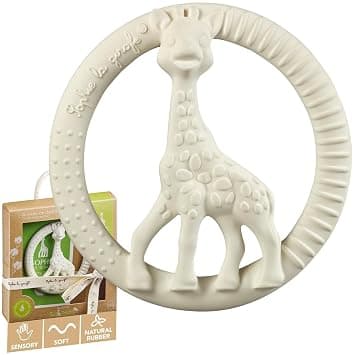
Sophie la girafe So'pure Circle Teether
The original Sophie la girafe, made of natural rubber over a painted surface with a squeaker built into the body, became national news in 2017 when parents cut open used units and found mold growing inside the sealed cavity around the squeaker. There was no formal recall. The manufacturer's own care instructions say to wipe the surface with a damp cloth rather than submerge or run it under water, because water that gets into the squeaker chamber has nowhere to dry. The So'pure line is Vulli's own response, a simpler natural-rubber ring shape with no internal squeaker cavity to trap moisture in the first place. If the brand recognition and the natural-rubber material matter to you, this is the version of it worth buying, not the original.
We may earn a commission on this link. It never changes the ranking.
- Material
- Natural rubber
- Construction
- Single molded ring, no internal cavity
- Care
- Wipe with a damp cloth, do not submerge
- Age
- 0 months and up
What works
- Solid natural rubber with no internal squeaker chamber to trap moisture
- Simple ring shape a young infant can grip before a developed pincer grasp
- 60-plus years of the underlying material and brand, so replacement parts and info are easy to find
What to know
- Natural rubber costs more than silicone for a plainer shape
- Rubber degrades with heat, so it is a hand-wash item, not a dishwasher or boiling one
- The name recognition is carrying most of the price here
$9.99
Price checked Sep 4, 2026
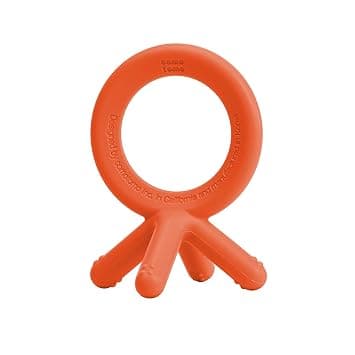
Comotomo Silicone Baby Teether
A one-piece food-grade silicone teether shaped to sit across the whole hand rather than a single finger's width, from the same company that makes the Comotomo bottle. There is no seam, no hollow cavity, and no color coating to wear off, which is most of the case for it. It is dishwasher-safe on the top rack and can go in the freezer for a firmer, colder chew, which is the same cold-and-counter-pressure mechanism every product on this list is using, just without the branding around it.
We may earn a commission on this link. It never changes the ranking.
- Material
- Food-grade silicone
- Construction
- Single molded piece
- Care
- Dishwasher and freezer safe
- Age
- 3 months and up
What works
- Single molded piece with no seam or hollow chamber
- Dishwasher-safe, so cleaning is not a special routine
- Freezer-safe for a firmer, colder texture some babies prefer
- Under ten dollars
What to know
- Plain shape with no texture variation, which some babies find less interesting than a knobbed or ridged surface
- Large enough to be easy to hold but too big to be discreet in a diaper bag pocket
- No handle or loop, so it goes on the floor and stays there until it is picked up
$6.99
Price checked Sep 4, 2026
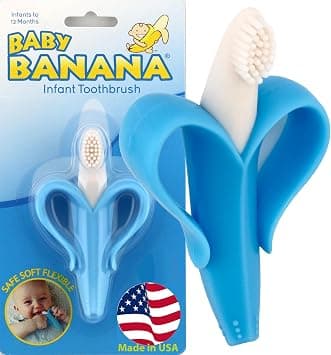
Baby Banana Original Teether-Toothbrush
Shaped like a banana with soft silicone bristles instead of a handle-and-head toothbrush shape, built specifically so it looks and feels like a chew toy while doing the job of introducing the brushing motion. The American Academy of Pediatrics recommends starting oral care once the first tooth appears, and a curved bendable handle a baby can hold themselves gets a parent past the resistance a rigid toothbrush handle usually creates at this age. It has been on the market since 2009 with the same core design, which is a longer track record than most of this category.
We may earn a commission on this link. It never changes the ranking.
- Material
- Food-grade silicone
- Construction
- Single molded piece with bristle texture
- Care
- Dishwasher safe
- Age
- 0 to 12 months, sized up as teeth arrive
What works
- Doubles as a first toothbrush once a tooth erupts, which the plain teethers here do not
- Bendable and soft enough to be safe if it hits the back of the mouth
- One of the least expensive options in the category
What to know
- The bristles are a texture some babies reject outright while others prefer them to a smooth surface
- It is not a substitute for a parent-held brush once several teeth are in
- Silicone bristles need to be checked periodically for tearing at the base
$15.25
Price checked Sep 4, 2026
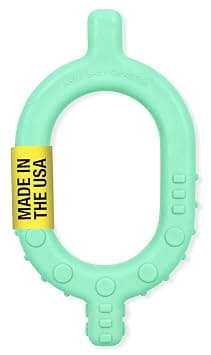
ARK's Baby Grabber, Firm
Designed by a speech-language pathologist as an oral-motor tool rather than a novelty teether, and shaped so one half of the loop is smooth and the other is textured, which puts two different sensory surfaces on a single piece a baby can hold by the loop. ARK makes it in its own factory in Columbia, South Carolina, from medical-grade elastomer rather than silicone, at 4.4 inches tall by 2.5 wide by 0.45 thick, and sells it in two color-coded firmness levels: soft for more give, firm for more resistance to the jaw. This is the firm one. It is not a medical device and nothing here diagnoses or treats anything. Read ARK's own label before the marketing, though: the company classes this as a therapy tool rather than a toy, for ages five months and up, with direct supervision, which is a stricter instruction than anything else on this list carries.
We may earn a commission on this link. It never changes the ranking.
- Material
- Medical-grade elastomer
- Construction
- Single piece, smooth half and textured half
- Care
- Hand wash or top-rack dishwasher
- Age
- 5 months and up, direct supervision
What works
- Designed by a speech-language pathologist for oral-motor engagement, not just teething
- Made in the USA in ARK's own factory from medical-grade elastomer, third-party tested by accredited labs
- Smooth on one half and textured on the other, so one piece covers two kinds of sensory input
- Two firmness levels, so the resistance can be matched to how hard a particular baby bites
What to know
- Costs more than the plain silicone options here
- ARK labels it a therapy tool rather than a toy and asks for direct supervision, which the single-piece teethers above do not
- Firmness is a guess until you own one, and each firmness is sold separately
- Marketed heavily toward therapy use, which is unnecessary framing for a family that just wants a teether
$9.99
Price checked Sep 4, 2026
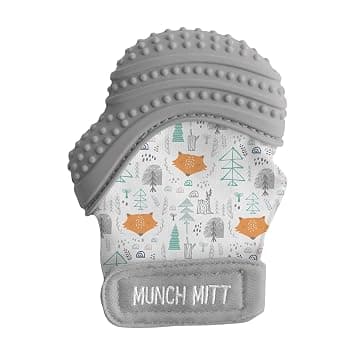
Malarkey Kids Munch Mitt Teething Mitten, Grey Fox
A textured food-grade silicone teething surface built into the palm of a soft mitt that straps around a baby's hand, rather than a separate object a baby has to pick up, aim and hold. The entire design exists to solve one specific failure mode of every teether above it on this list: a young infant who has not yet developed the coordination to bring an object to their mouth reliably, and who drops a loose teether on the floor within a minute of getting it. The teething surface stays in reach because it is attached to the hand doing the reaching. Malarkey Kids recommends it for roughly three to eight months and says it stays usable to about twelve, the narrowest window of anything here, so this is a stage purchase rather than a two-year one. The mitt is a bamboo and cotton blend with nylon and polyester, machine washable, and carries a crinkle layer and high-contrast pattern that give a baby something to hear and look at while chewing.
We may earn a commission on this link. It never changes the ranking.
- Material
- Food-grade silicone chew surface, bamboo-cotton blend mitt
- Construction
- Silicone insert secured into fabric mitt
- Care
- Machine washable
- Age
- About 3 to 8 months, usable to 12
What works
- Solves the drop-on-the-floor problem inherent to every unattached teether on this list
- Usable earlier than a hand-held teether, since it does not require aim-and-grasp coordination
- Machine washable, which the plush wrap of a loose teether toy rarely is
- Adjustable strap, so it stays on a hand that would otherwise fling it across the room
What to know
- The maker's own recommended window is about three to eight months, so it is outgrown faster than any other teether here
- The mitt itself is a fabric blend, which is not the same food-grade silicone claim as the chew surface and needs its own separate cleaning attention
- An older baby who already has good hand-to-mouth coordination will often just pull it off
- More moving parts (strap, mitt, silicone insert) than a single-piece teether has
What to skip
Anything with beads, gems or other decorative pieces attached by glue or a separate fastener rather than molded as one piece. The 2017 recall review covered in what the small parts test actually checks found that a meaningful share of choking incidents involved parts that had separated from a larger toy rather than parts that were small from the factory, and a decorated teether with glued-on pieces is exactly that shape of risk. A wooden teething ring with a painted or varnished surface is the same concern in a different material: paint and varnish are not designed to be chewed continuously, and a plain unfinished or food-safe-oiled wood ring is the safer version of the same idea.
Skip anything marketed as a liquid-filled or gel-filled teether meant to go in the freezer. Liquid-filled teethers have a documented history of leaking or cracking under a baby's bite, and once the shell fails there is no way to know what the fill liquid is or to get it back out of a baby's mouth quickly. A solid silicone or rubber teether gets just as cold in the freezer without that failure mode.
Where a teether fits against everything else at this age is covered in toys by development stage, and once a baby has enough teeth to move on to real chewables, the best first toys picks up from here on what still earns its shelf space a year later.
Recall note, September 2026
On 17 September 2026 the Consumer Product Safety Commission announced a recall of SHEIN "Pull and Chew" Montessori teething toys, about 644 units, sold on SHEIN.com between December 2025 and April 2026 for around $10. The silicone strings on the toy are smaller and longer than the mandatory toy standard permits, so a string can reach the back of a child's throat and become lodged. CPSC recorded no incidents. The remedy is a refund: cut the silicone strings off and email a photo to the address in the notice.
It is worth reading alongside the "what to skip" list above, because the failure is the same one described there in a different form. The hazard is not a bead glued on badly, it is a flexible attached part whose dimensions were never inside the limit, and a string is the shape of attached part that is easiest to look at and assume is fine. Full notice: SHEIN Distribution Corporation Recalls Pull and Chew Montessori Teething Toys.
Sources
- The Bump, "What To Do About The Sophie La Girafe Mold Problem"
- AAP, "Teething: What Parents Need to Know"
- 16 CFR Part 1501, small parts regulation
Questions people actually ask
Should a teether go in the freezer or just the fridge?
The fridge is the safer default. Cold rather than frozen provides the counter-pressure and numbing effect, and a teether frozen solid for hours can be hard enough to bruise a baby's gums on contact. If you do use the freezer, a short chill of 15 to 20 minutes is enough.
Is natural rubber safer than silicone?
Neither material is inherently safer; both are used in products that meet the same federal toy safety requirements under 16 CFR Part 1250. The differences that matter are construction, which is why single-piece designs are favored throughout this guide, and a documented latex allergy, which rules out natural rubber for a small number of children.
Do teething toys actually help, or is it mostly the cold?
The mechanism is almost entirely counter-pressure and cold, not the specific product. A clean cold washcloth does the same job as a $20 teether. What a purpose-built teether adds is a shape designed for a baby to hold and mouth safely, which a washcloth is not.
How many teethers does a baby actually need?
Two or three in rotation covers most of the first two years: one to have in use, one chilling in the fridge, and one as backup while the others are being washed. More than that is redundant rather than protective.
When do babies stop needing a teether?
There is no fixed age. It tracks tooth eruption, which typically continues in bursts through around age two to three as molars come in, and most families phase teethers out on their own once a toddler has enough teeth and enough other things to chew on that the specific need fades.
As an Amazon Associate we earn from qualifying purchases. We earn a commission on some links, at no extra cost to you. It never changes which products we recommend or the order they appear in. Full disclosure

Who wrote this
Writer, standards and the recall record
Dan Whitfield writes the standards side of BabyGearSearch: what a certification actually covers, what the CPSC recall database says about a brand, and what the one-star reviews agree on six months in. He is not a clinician and does not write as one. His job is to read the standard rather than the marketing page, quote the real number, and name the limit the packaging skipped.
More from DanThe standard
How this guide was built
- Manufacturer specification sheets and warranty terms, read in full rather than summarised from a listing.
- The federal safety standard the product is certified to, plus anything NHTSA, the AAP or the CPSC has published on it.
- Owner reports at volume, including the one-star reviews, which is where failure modes live.
- Every price checked against the live listing on the date printed beside it.