How Much Screen Time Is Actually Recommended Before Age 2?
WHO says none under a year and caps stroller or high-chair time at an hour. The AAP draws its line at 18 months with one exception. Both guidelines, in full.
- Writer, standards and the recall record
- Sep 9, 2026
- 9 min read

In this guide
The rule most parents have heard is "no screens before two," and it is close enough to be useless. The two bodies that actually publish guidance on this, the World Health Organization and the American Academy of Pediatrics, draw the line in different places, attach different exceptions to it, and both say considerably more about what should fill the time than either gets credit for. Neither guideline is really about screens on their own. Both are about what an infant's day is made of, and a screen is one entry on a longer list that also includes the stroller, the high chair and the floor.
What the WHO guideline actually says
The document is the WHO's 2019 Guidelines on Physical Activity, Sedentary Behaviour and Sleep for Children Under 5 Years of Age, and it treats screen time as one part of a 24-hour framework alongside movement, restraint and sleep. For infants under 1 year, the recommendation is unambiguous: "screen time is not recommended." At 1 year it holds: sedentary screen time such as television, video or computer games is still not recommended. It loosens only at 2 years, where the ceiling becomes one hour, with the guideline adding "less is better."
The physical activity side of the same document is the part most screen-time coverage skips. Infants should "be physically active several times a day in a variety of ways, particularly through interactive floor-based play," and the guideline states plainly that "more is better." For an infant who is not yet mobile, that includes a specific number: at least 30 minutes in the prone position, spread across the day while awake, which is the guideline's formal name for tummy time.
The restraint rule is the one with the least name recognition and the most practical bite. The WHO recommends that infants "not be restrained for more than 1 hour at a time," and it names the equipment explicitly: prams and strollers, high chairs, and being strapped to a caregiver's back. That single line covers three pieces of gear most households already own, and it has nothing to do with a screen being present. A baby buckled into a stroller for a two-hour walk with no device in sight is still over the guideline's own limit, because the guideline is measuring immobility, not media.
Sleep sits in the same document for a reason: 0 to 3 months should get 14 to 17 hours of good-quality sleep including naps, and 4 to 11 months should get 12 to 16 hours. The three domains, movement, restraint and sleep, are graded together because the WHO's working theory is that a day is a fixed 24 hours and time spent in one column is time unavailable to another.
What the AAP guideline actually says
The AAP's line sits at 18 months rather than 1 year, and it carries one specific exception. Media use is discouraged for children under 18 months, with video chatting, a call to a grandparent over FaceTime or a similar app, treated separately because it is reciprocal: a caregiver's face is present, responding in real time, in a way a recorded video is not. That distinction is the entire basis of the exception. A video of a face is not the same category as a video call with one.
Between 18 and 24 months, the AAP's position is not a wider door so much as a narrower set of conditions. Parents who choose to introduce digital media in that window are directed toward high-quality programming, watched together with a caregiver rather than handed over solo. The guidance is explicit that the value in that stage comes from the co-viewing, since a toddler this young has not yet developed the ability to transfer what a screen shows into the physical world without an adult narrating the bridge.
The AAP's policy statements on this, Media and Young Minds from its Council on Communications and Media and the more recent Digital Ecosystems, Children, and Adolescents, break recommendations down by developmental stage rather than by a single number, and the 0-to-5 age band is where the 18-month line and the co-viewing condition both live. Where the two organizations differ is mostly cosmetic: WHO's 1-year threshold and the AAP's 18-month threshold are six months apart on paper and functionally identical in practice, since both are describing the same developmental reality, that an infant this age gets nothing usable from a screen and gets language and social learning from a responsive adult face instead.
The rule that has nothing to do with a screen
The restraint limit is worth pulling out on its own, because it is the part of the WHO guideline a parent can violate without a device anywhere in the house. A car seat used for actual transport is a separate case the guideline treats on its own terms. What the one-hour figure measures is discretionary immobility: the stroller left buckled after the walk is over, the high chair used as a holding pen between meals, an infant carried on a caregiver's back for a long stretch with no chance to get to the floor.
Our stroller guide and the high chair that fits a small kitchen are both written around fit and footprint, and that is worth naming as a gap: the equipment itself enforces no limit at all. The limit is a parenting decision. The practical version of it is simple: treat time in either seat as bounded, and plan for the floor time on the other side of it.
What actually fills the recommended floor time
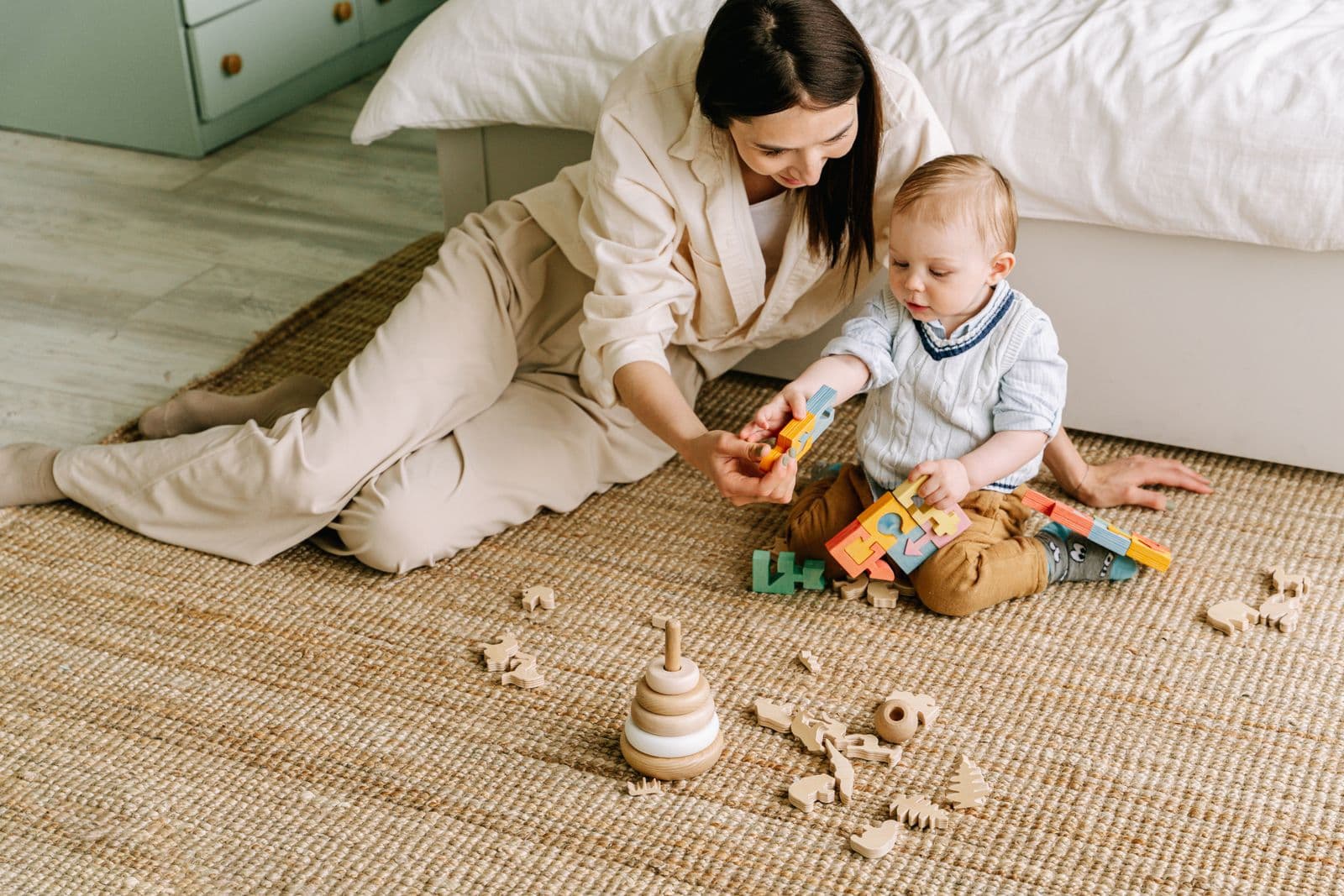
Interactive floor-based play is not a specific product, and the WHO guideline does not require one. It requires proximity to an adult and freedom of movement, which a blanket on a clean floor provides for free. Where equipment earns its keep is in giving a non-mobile infant a reason to lift the head and track an object, which is the actual mechanism behind tummy time working better on a play gym than on a bare rug. Play gyms and activity centers covers which of that category earns its floor space and which pieces, like a mobile infant walker, work against the goal by putting an infant upright and moving without using their own muscles to get there.
Matching a toy to what an infant can actually do at a given month, rather than buying for an age eight months out, is the subject of toys by development stage, and it is a more useful frame for the floor-time hours than any single product recommendation. The overlap with screens is closer than it looks: a toy that includes a screen is a screen for the purposes of both guidelines, regardless of what the packaging calls it, and do developmental toys actually work covers the one controlled trial that measured why electronic toys change the interaction itself, not just the content on the toy.
What this changes about a typical day
Nothing here argues for eliminating the stroller, the high chair or an occasional video call to a grandparent. It argues for treating all three as bounded rather than default, and for noticing that the floor is doing developmental work that a bouncer or a screen is not built to do. A caregiver reading a board book during a sedentary stretch, which both guidelines mention approvingly, satisfies the same slot a screen would have filled and does it with a responsive adult attached.
Questions people actually ask
Is video chatting with a grandparent really different from watching a video?
The AAP treats them as different categories because a video call is reciprocal: the person on the other end is responding in real time to the infant's expressions and sounds, which is the same kind of contingent interaction an infant gets from an in-person caregiver. A recorded video, however engaging, cannot respond to anything the infant does.
Does the WHO restraint rule include car seat time during actual driving?
The guideline's own examples are prams, strollers, high chairs and being carried on a caregiver's back, all of which describe discretionary immobility rather than transportation. A car seat used to drive somewhere is a different case, though the same logic argues for a break and floor time on arrival rather than leaving an infant in the seat longer than the trip requires.
What if my baby hates tummy time?
Short, frequent sessions beat one long one, and starting on a caregiver's chest rather than the floor lowers the difficulty while still building the same neck and shoulder strength. The WHO's 30-minute figure is a daily total spread across the day, not one sitting, and it is worth confirming there is no physical reason for the resistance with a pediatrician if it does not improve over a few weeks.
Is a tablet with a baby-branded educational app an exception to the 18-month line?
No. The AAP's guidance does not exempt content based on marketing claims about educational value. A screen showing curated content is still a screen, and the video-chat exception is specifically about the reciprocal, real-time nature of a call, not about content quality.
My toddler is 20 months and we already introduced some TV. Is the guidance saying we did something harmful?
No. These are population guidelines describing what the evidence supports as generally best, not a threshold with a harm cliff on the other side. The AAP's own guidance for the 18-to-24-month window assumes some families will introduce media in that range and directs them toward high-quality, co-viewed content rather than telling them to stop.
Sources
- WHO Guidelines on Physical Activity, Sedentary Behaviour and Sleep for Children Under 5 Years of Age, full text
- WHO, Guidelines on physical activity, sedentary behaviour and sleep for children under 5 years of age
- HealthyChildren.org (AAP), Helping Kids Thrive in a Digital World: AAP Policy Explained
As an Amazon Associate we earn from qualifying purchases. We earn a commission on some links, at no extra cost to you. It never changes which products we recommend or the order they appear in. Full disclosure

Who wrote this
Writer, standards and the recall record
Dan Whitfield writes the standards side of BabyGearSearch: what a certification actually covers, what the CPSC recall database says about a brand, and what the one-star reviews agree on six months in. He is not a clinician and does not write as one. His job is to read the standard rather than the marketing page, quote the real number, and name the limit the packaging skipped.
More from DanThe standard
How this guide was built
- Manufacturer specification sheets and warranty terms, read in full rather than summarised from a listing.
- The federal safety standard the product is certified to, plus anything NHTSA, the AAP or the CPSC has published on it.
- Owner reports at volume, including the one-star reviews, which is where failure modes live.
- Every price checked against the live listing on the date printed beside it.