Changing Table Safety: What the Federal Rule Tests, and Why It Does Not Require a Strap
16 CFR 1235 tests barriers, stability and any strap supplied, but makes the strap optional on purpose. The fall data, the label check and the rule that works.
- Editor, gear and the arithmetic of a small home
- Oct 10, 2026
- 14 min read

In this guide
Every changing table, add-on changing unit and contoured changing pad sold in the United States has to meet a federal safety standard. Most parents assume that standard requires a safety strap. It does not, and the reason the Consumer Product Safety Commission gave for leaving it out is the most useful sentence in the whole rulemaking.
When a commenter asked the CPSC in 2018 to make restraint straps mandatory, the agency declined. Restraints, it wrote, "may give caregivers a sense of safety, diminishing their attentiveness, and increasing potential hazards." A caregiver who trusts the strap may walk away, and an unattended baby held by a single waist strap is exposed to a strangulation hazard. So the rule tests any strap a manufacturer chooses to supply, and leaves the real safety device where it has always been: the adult's hand.
This guide covers what the federal rule actually checks, what the injury record shows, which products it does not reach, and how to set up a changing station so that the strap never has to do the job.
What the rule covers
The rule is 16 CFR Part 1235, the Safety Standard for Baby Changing Products. It was published on 26 June 2018 and took effect a year later. It incorporates the voluntary standard ASTM F2388 by reference, which turns that industry document into federal law. Products made after 26 June 2019 had to meet ASTM F2388-18, and products made after 31 July 2022 must meet the revised ASTM F2388-21.
The standard defines four kinds of product, and only these four are covered:
- Changing table. An elevated, freestanding structure designed to hold a child of up to 30 pounds lying down for a diaper change. That includes tables that convert to or from a dresser, desk or bookshelf, and pull-out or drop-down changing surfaces.
- Changing table accessory. A frame that attaches to a crib or play yard to turn it into a changing table, usually rigid with fabric or mesh.
- Add-on changing unit. A rigid tray or set of barriers that sits on top of a piece of furniture, the kind most people call a dresser topper.
- Contoured changing pad. A pad with raised edges designed for use on an elevated surface.
Two things fall outside it. A flat, non-contoured changing mat, the fold-out kind that comes with a diaper bag, is not a baby changing product under the definition and is not subject to the standard. The fold-down tables in public restrooms are covered by a different standard for commercial use, ASTM F2285, not by Part 1235.
What the injury record shows
The CPSC's 2018 rulemaking pulled together every report it held. Between January 2005 and November 2017 it received 188 reports of incidents involving baby changing products, including seven deaths and 31 injuries. Its emergency department sample produced a far larger number: an estimated 39,010 injuries to children under three, treated in U.S. emergency departments between 2005 and 2016, with a statistically significant upward trend across the period.
The detail in that sample is what matters for a parent:
- Age. 76% of the injured children were under 12 months old, and 94% were under two.
- Body part. The head accounted for 71 to 73% of injuries, depending on the period, and the face for another 12 to 13%.
- Severity. 94% were treated and released, and about 5% were admitted to hospital. Roughly half were coded as internal injuries, and 8 to 9% were fractures.
The agency's more recent figures point the same way. Its November 2022 report on nursery products estimated 3,400 emergency department visits involving changing tables for children under five in 2019, 2,600 in 2020 and 3,800 in 2021. The rise from 2020 to 2021 was one of only three that reached statistical significance in that report. Across all nursery products, falls were the leading cause of injury, and about 68% of injuries involved the head and face.
Independent research agrees on the pattern. A Greek study of 2,672 injured infants found that changing tables were associated with roughly four falls per 1,000 infant-years, about the same rate as bouncers and strollers, and that about 10% of infants with fall injuries needed hospital admission. A 2026 analysis of the South Korean national emergency department registry found that falls during a diaper change made up only 0.6% of fall injuries in children under three. Yet 47.3% of those children had a traumatic brain injury, against 31.0% for other falls, and 16.4% were severely injured, against 6.1%.
Small numbers, high consequence. A changing surface is waist height for an adult, which puts a baby's head well above a hard floor.
The deaths were not mostly falls
The seven deaths in the 2018 record are worth reading closely, because only one of the hazards is the obvious one.
Five of the babies died while sleeping on a changing product, which is not what any of them is for. One was a four-month-old asleep on a changing pad placed inside a crib, whose head hung over the raised side. Three were infants asleep in the changing accessory of a play yard. A fifth was a newborn on the changing portion of a play yard. Of the remaining two, a three-month-old rolled and compressed her neck against the ledge of a changing table, and a ten-month-old in a play yard was strangled by a strap hanging from the changing accessory above him.
That is why the rule's warnings cover three things rather than one: falls, the correct securing of attachable changing products, and the suffocation risk of letting a baby sleep on one.
What the standard tests
The CPSC's business guidance lists the performance requirements. In plain terms, a compliant product has been checked for:
Barriers. Raised edges that stop a baby rolling off the changing surface. This is the core of the contoured pad and the add-on unit, and the reason a flat mat does not qualify.
Stability and structural integrity. The table must stay upright and hold together. The structural test is deliberately run without any consumer-installed secondary support straps or bars, because people skip them or fit them wrongly. Consumer-assembled key structural parts cannot rely on wood screws driven straight into wood, and factory-installed metal fasteners need a way of resisting loosening, such as lock washers.
Retention. A contoured pad or an add-on changing unit has to stay attached to the furniture it sits on.
Entrapment. Enclosed openings and shelves are checked for entrapment. Some tables have steps for an older toddler to climb, and self-folding steps are tested too.
Restraints, if fitted. Here is the detail behind the strap. When a product comes with one, the strap is fastened around a test dummy and pulled in four directions with 30 pounds of force. It passes only if neither strap nor buckle breaks and nothing separates more than one inch from where it started. That test answers the failure the CPSC actually saw in its incident reports, which was restraints detaching or buckles breaking. It does not make the strap a reason to step away.
Warnings. The 2021 revision of the standard put "FALL HAZARD" in capitals at the head of the fall warning, to make it harder to skim past.
What the standard does not reach
A standard applies to the product on the day it was made, and it tests the product, not the room.
- The dresser underneath. A dresser carrying a changing topper is a clothing storage unit. Its tip-over stability is governed by a separate rule, and the topper standard does not check whether the chest will stay on its feet. That is covered in anchoring nursery furniture.
- Products made before June 2019. A secondhand changing table from before then may never have been tested to any of this. Check the label.
- A pad on the wrong surface. A contoured pad is designed and tested for an elevated surface it can be fixed to. Placed on a bed, a sofa or the floor of a crib, it is being used in a way the test never examined, and a crib is where one of the deaths happened.
- Your attention. No part of the test simulates a caregiver turning round for the wipes.
How to check a changing product you already own
Durable infant products must carry a permanent label under 16 CFR 1130.4: the manufacturer's or importer's name, a U.S. address and phone number, the model name or number, and the date of manufacture, at least to the month and year. The product should also have come with a registration card, which exists so the maker can reach you about a recall.
- Find the date. Made after 26 June 2019 means the product had to meet the federal standard. Earlier than that is not automatically unsafe, but it carries no such assurance.
- Look up the model in the CPSC recall database, using the model number from the label rather than the product's marketing name.
- Check the barriers. The American Academy of Pediatrics' parent site advises a guardrail of 2 inches around all four sides and a concave surface, slightly lower in the middle than at the edges. A topper with rails on only three sides relies on the wall for the fourth.
- Check the fixing. A contoured pad should be fastened to the furniture beneath it as the instructions describe, not resting loose on top.
- Register it if the card is still around. A recall notice is only useful if it reaches you.
Setting up so the strap is never the plan
The AAP's advice is short: buckle the safety strap, but do not depend on it, and never leave a child unattended on a changing table, even for a moment, even if strapped. Everything below is about making that rule easy to keep.
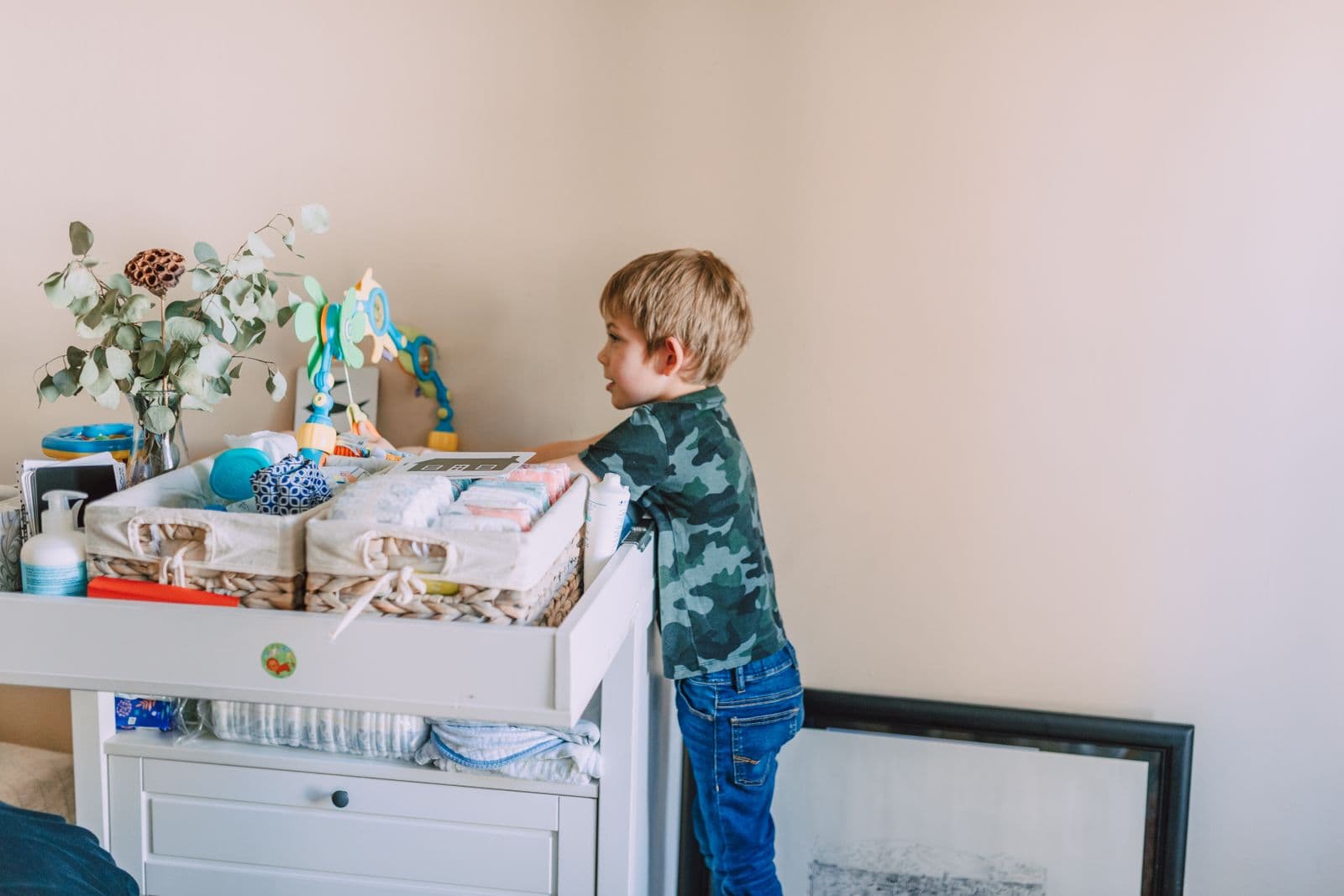
Stock the station before the change. The AAP's own wording is to keep diapering supplies within your reach but out of your child's. The single fall among the CPSC's 2016 to 2017 incident reports was an 11-month-old who went off a changing table while the caregiver was distracted. Diapers, wipes, cream, a clean outfit and a bag for the dirty one should all be within an arm's length of where your hand rests on the baby.
Decide what happens when the doorbell rings. Pick up the baby or put the baby on the floor. Those are the only two options. A changing table is not somewhere to wait.
Change on the floor when the table stops working. A baby who rolls and twists through every change is better changed on a mat on the floor. A floor has no fall height at all, and that is the fix the standard cannot provide.
Never let the baby sleep there. Five of the seven deaths in the federal record were babies asleep on a changing product. If the baby dozes off mid-change, move them to a crib, bassinet or play yard with a bare, flat, firm sleep surface. The full set of sleep-surface rules is in what the Safe Sleep for Babies Act banned.
Clear the play yard of the changer before sleep. If a play yard has a changing accessory, remove it before the baby sleeps underneath, and keep straps from hanging into the space below. Play yard setup is covered in the best travel cribs and pack 'n plays.
Keep cords and the diaper pail out of reach. A monitor cable, a lamp flex or a pail lid within reach of a changing baby is something to grab and pull.
Choosing between a table and a topper
The safety standard does not decide this for you. Both a freestanding changing table and an add-on unit on a dresser are covered products, and both can be compliant. The practical differences are barriers (a dedicated table usually has them on all four sides) and longevity (a dresser outlasts the nursery by a decade). The height arithmetic and the long-term argument are set out in changing table or dresser topper.
Questions people actually ask
Does a changing table have to come with a safety strap?
No. The federal standard, 16 CFR Part 1235, does not require one. The CPSC declined to make straps mandatory in 2018 because they can give caregivers a false sense of security and a single waist strap poses a strangulation hazard to an unattended baby. If a strap is supplied, it must pass a 30-pound pull test in four directions.
Is it safe to use the strap?
Yes, as a backup. The American Academy of Pediatrics advises buckling it but never depending on it, and never leaving a baby unattended on a changing surface even when strapped. The strap is there for a wriggle, not for a walk across the room.
Is a changing pad on top of a dresser covered by the same rule?
The contoured pad and any add-on changing unit are covered, including a requirement that they stay attached to the furniture. The dresser itself is a clothing storage unit under a separate tip-over rule, so it still needs anchoring to the wall.
Are diaper bag changing mats covered?
No. A flat, non-contoured mat of the kind included with a diaper bag is outside the definition of a baby changing product and is not subject to the standard. Use one on the floor or a wide, low surface.
How can I tell if an old changing table meets the standard?
Find the permanent label that shows the date of manufacture. Products made after 26 June 2019 had to meet ASTM F2388-18, and products made after 31 July 2022 must meet ASTM F2388-21. Then check the model in the CPSC recall database.
My baby fell off the changing table. What should I do?
For a baby under one year with a head injury, the AAP's guidance is to call your doctor or seek care now. Call 911 for a seizure, unconsciousness lasting more than a minute, a baby who is hard to wake, a neck that is not moving normally, or anything you believe is life-threatening.
Sources
- CPSC, Baby Changing Products Business Guidance, 16 CFR part 1235
- Federal Register, Safety Standard for Baby Changing Products, final rule, 83 FR 29672, 26 June 2018
- Federal Register, Safety Standard for Baby Changing Products, direct final rule, 26 April 2022
- CPSC, Injuries and Deaths Associated with Nursery Products Among Children Younger than Age Five, November 2022
- American Academy of Pediatrics, HealthyChildren.org, Changing Table Safety
- American Academy of Pediatrics, HealthyChildren.org, Head Injury symptom checker
- Dedoukou X, et al. Incidence and risk factors of fall injuries among infants: a study in Greece. Arch Pediatr Adolesc Med, 2004, 158(10), 1002-1006
- Kim M, et al. Traumatic brain injury from diaper change-related falls in children younger than 3 years. BMC Pediatr, 2026, 26(1), 77
- CPSC recall database
As an Amazon Associate we earn from qualifying purchases. We earn a commission on some links, at no extra cost to you. It never changes which products we recommend or the order they appear in. Full disclosure

Who wrote this
Editor, gear and the arithmetic of a small home
Marisa Okonkwo edits BabyGearSearch and writes the hardware half of it: strollers, car seats, carriers and the furniture around them. She reads the specification sheet, the fit list and the returns policy in full before she reads a single review, because the difference between two apparently identical strollers is almost always a number one of them declines to publish.
More from MarisaThe standard
How this guide was built
- Manufacturer specification sheets and warranty terms, read in full rather than summarised from a listing.
- The federal safety standard the product is certified to, plus anything NHTSA, the AAP or the CPSC has published on it.
- Owner reports at volume, including the one-star reviews, which is where failure modes live.
- Every price checked against the live listing on the date printed beside it.