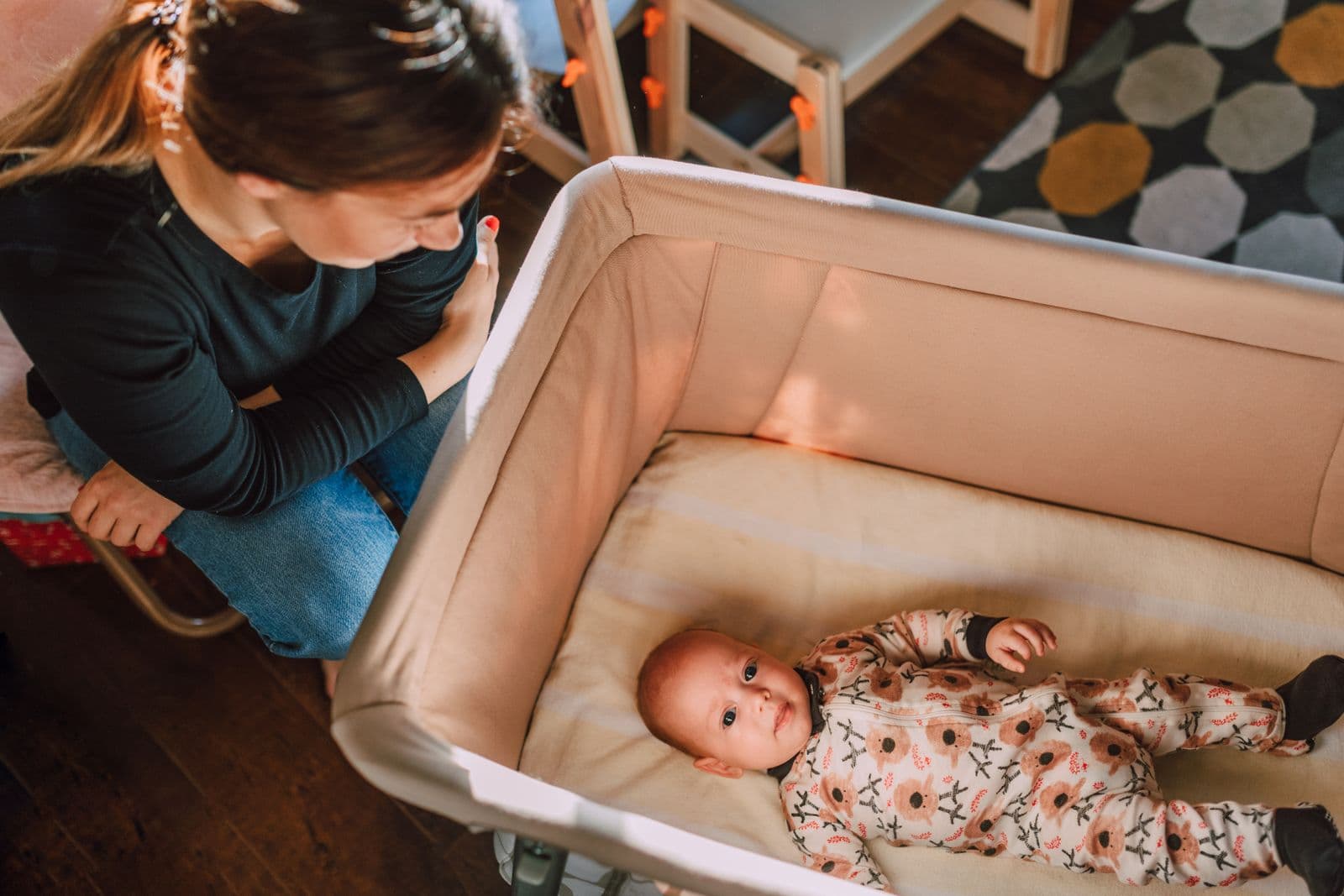
The Best Baby Monitors for Twins, Judged on the Split Screen Nobody Explains
Four dual-camera monitors compared on what a real twin split screen needs: audio from both rooms at once, not just two windows of picture.
- Writer, standards and the recall record
- Sep 16, 2026
- 13 min read
4 products compared

In this guide
Two babies do not need two monitors so much as they need one monitor that answers a question a single-camera product was never built to answer: which room needs you right now. Point a standard monitor's camera at one crib and buy a second monitor for the other, and you end up on the couch with two handheld units, watching two small screens, listening for whichever one gets loud first. That works for a week. It does not work at three in the morning on week twelve.
A dual-camera monitor with a real split screen solves the mechanical half of that problem: one screen, two feeds. What it does not automatically solve is audio, and that is the part almost nobody explains before you buy. A screen that shows two pictures at once and a screen that plays two rooms' sound at once are different products wearing the same description, and the gap between them is exactly the moment a quiet baby starts crying in the room you are not currently listening to.
What "for twins" actually has to mean
Audio from both rooms at once. Every monitor below can show two video feeds at once. Fewer of them can play both microphones at once. Some split-screen units default to full audio from whichever camera is currently selected or largest on screen, and give you the second room's sound only if you tap over to it. For one baby that is a non-issue. For two, it is the difference between hearing a cry the instant it starts and hearing it once you happen to glance at the right half of the screen.
Each baby needs their own sleep surface. The reason a twins monitor exists at all is that federal safe-sleep guidance treats twins the same way it treats any two infants: each one needs their own sleep space. The Safe to Sleep campaign, run by the National Institutes of Health, states plainly that a baby is at lower risk for injury and death "in their own sleep space (crib, bassinet, or portable play yard)... separate from your bed," and that wedges, positioners and dividers marketed to fit two babies into one surface do not meet federal sleep-safety guidelines and are linked to injury and death when used in a baby's sleep area. Two cribs means two things to watch, which is the whole reason this category exists.
Range that covers the actual distance between two rooms. A figure measured to one nursery is the wrong number if the twins sleep in separate rooms; what matters then is whether the signal reaches whichever room sits farther from the parent unit.
Battery life that survives a night where you are not going back to a charger, because with two children waking on two schedules, a monitor that needs a midnight top-up is a monitor you will resent.
The picks
$299.99
Price checked Sep 16, 2026
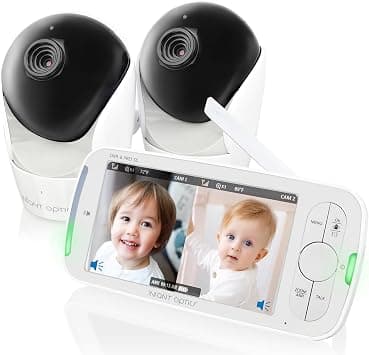
Infant Optics DXR-8 PRO SS (Split-Screen)
The one built specifically to solve the audio problem, not just the video one. Infant Optics calls it Simultaneous Dual Audio (SDA), and the point of the name is the point of the product: both microphones stay live at once instead of handing you audio from whichever camera is on top. It is the most expensive monitor here, and it is the one to buy if the audio gap is the reason you are shopping in the first place.
We may earn a commission on this link. It never changes the ranking.
- Screen
- 5-inch split-screen, no Wi-Fi
- Audio
- Simultaneous Dual Audio, both cameras at once
- Cameras included
- 2, expandable
- Standout
- Patented dual audio, interchangeable lenses
What works
- Patented Simultaneous Dual Audio plays both rooms at once instead of switching between them
- Interchangeable lens system lets you swap a wide-angle lens into either camera without buying a new unit
- No Wi-Fi, so range and reliability do not depend on your router reaching two rooms instead of one
- Remote pan, tilt and zoom on each camera independently from the parent unit
What to know
- The most expensive of the four by a wide margin
- 5-inch screen is the smallest here to split between two feeds
- Add-on cameras for this model are not compatible with the standard DXR-8 PRO, so buy the SS version specifically
$194.95
Price checked Sep 16, 2026
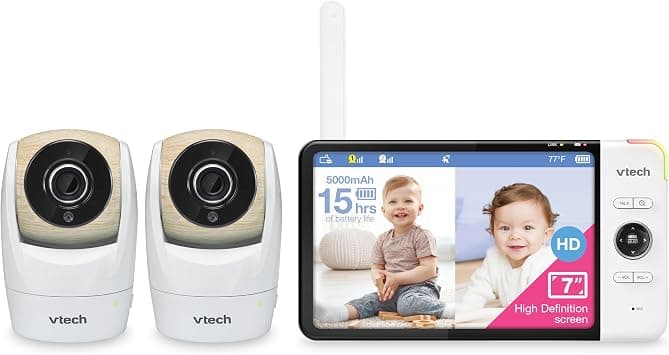
VTech VM919-2HD
The biggest parent-unit screen of the group at 7 inches, which matters more than it sounds like it should when that screen is split in half between two cribs. VTech's own listing describes a split-screen view for watching both rooms together and a separate patrol mode that cycles between cameras on a timer, which is a useful option when you want a full-size single feed rather than two half-size ones.
We may earn a commission on this link. It never changes the ranking.
- Screen
- 7-inch 720p split-screen, no Wi-Fi
- Range
- Up to 1000ft
- Cameras included
- 2, expandable to 4
- Standout
- Largest screen, longest published range
What works
- 7-inch 720p screen is the largest here, so each half of a split view is still a usable size
- Up to 1000ft range and support for up to four cameras total if a third child or room joins the setup later
- No Wi-Fi, encrypted transmission direct from camera to parent unit
- 360-degree pan and 100-degree tilt on each camera from the handheld
What to know
- Bulkier parent unit than the smaller-screen options here
- VTech's own material does not make the same simultaneous-both-cameras audio claim Infant Optics does, so confirm the audio behavior you need before buying if that is the deciding factor
- 720p, so do not expect it to out-resolve every rival on paper; the audio question above matters more for this use case anyway
$149.99
Price checked Sep 16, 2026
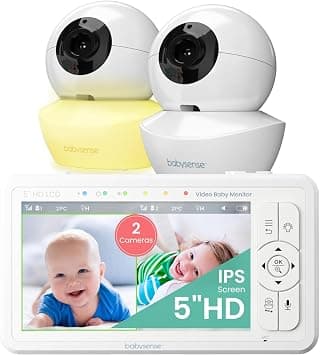
Babysense 5-Inch Split-Screen Baby Monitor
The value pick, and the one with the deepest battery for a household where somebody is up on a rotating schedule rather than a fixed one. It gives up the interchangeable-lens flexibility of the Infant Optics and the screen size of the VTech, and in exchange it is fifty to a hundred and fifty dollars cheaper than either.
We may earn a commission on this link. It never changes the ranking.
- Screen
- 5-inch split-screen, no Wi-Fi
- Battery
- 4000mAh
- Range
- 1000ft, 4X zoom
- Standout
- Battery life and price
What works
- 4000mAh battery is the largest capacity of the four
- 1000ft range and 4X zoom on each camera
- No Wi-Fi, split-screen viewing of both cameras at once
- The cheapest of the four picks by a real margin
What to know
- 5-inch screen, same size class as the Infant Optics and smaller than the VTech
- No published claim of simultaneous dual-camera audio, so treat the audio behavior the same way as the VTech until you have confirmed it on the unit in hand
- Fewer expansion options than the VTech's four-camera ceiling
$139.98
Price checked Sep 16, 2026
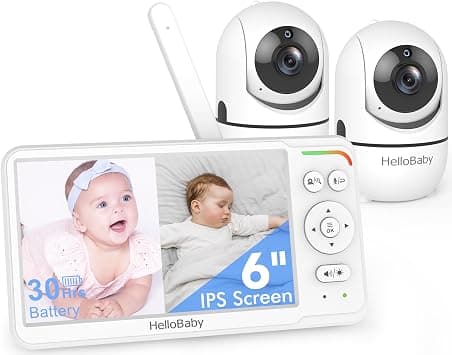
HelloBaby 6-Inch IPS Split-Screen Monitor with 2 Cameras
HelloBaby markets this one specifically for twins, and at this price it is the easiest of the four to justify buying without a second thought. The 6-inch IPS screen splits more comfortably than the 5-inch units above it, and the 30-hour eco-mode battery is close to the Babysense's without matching Infant Optics on the audio question.
We may earn a commission on this link. It never changes the ranking.
- Screen
- 6-inch IPS split-screen, no Wi-Fi
- Battery
- Up to 30 hours, eco mode
- Range
- 1000ft
- Standout
- Lowest price, marketed specifically for twins
What works
- Cheapest of the four picks, and the only one explicitly marketed for twin and two-room monitoring
- 6-inch IPS screen splits more comfortably than the 5-inch competitors
- Up to 30 hours of battery in eco mode
- No Wi-Fi, 1000ft range, pan-tilt-zoom on both cameras
What to know
- Newest and least-established brand of the four in this category, with a shorter track record than VTech or Infant Optics
- No published simultaneous-audio claim, same caveat as the Babysense and VTech
- Build quality reports on budget dual-camera monitors are more mixed than on the premium end of this list
The comparison, in one table
| Monitor | Price | Screen | Simultaneous dual audio | Battery |
|---|---|---|---|---|
| Infant Optics DXR-8 PRO SS | $299.99 | 5-inch | Yes, patented SDA | Not published |
| VTech VM919-2HD | $194.95 | 7-inch | Not published | Not published |
| Babysense 5-Inch Split-Screen | $149.99 | 5-inch | Not published | 4000mAh |
| HelloBaby 6-Inch IPS Split-Screen | $139.98 | 6-inch | Not published | Up to 30 hours (eco mode) |
Who each one is wrong for
The Infant Optics is wrong for a family on a tight budget, full stop. Its whole reason for existing is the dual-audio feature, and if that specific feature is not the deciding factor for you, the other three do the split-screen job for less.
The VTech is wrong for a nursery so small that a 7-inch parent unit feels oversized on a nightstand, and it is wrong if simultaneous audio from both rooms is the one thing you actually need, since VTech does not publish that claim the way Infant Optics does.
The Babysense is wrong for anyone who wants the interchangeable-lens flexibility of the Infant Optics or the largest possible screen, and right for a household that mostly cares about not hunting for a charger at 2am.
The HelloBaby is wrong for a family that wants the reassurance of a longer-established brand's track record, and right for anyone who wants to try true dual-camera monitoring at the lowest possible entry cost.
What we would actually buy
For most families with twins in separate cribs in the same room, the HelloBaby at under a hundred and forty dollars answers the actual question, which is whether you can see and hear both cribs from one screen without spending three hundred dollars to do it.
For a family where the audio gap described above is a real, specific worry, the extra hundred dollars for the Infant Optics buys the one feature none of the others publish: both microphones live at the same time, not just both pictures.
Questions people actually ask
Do twins need two separate baby monitors instead of one dual-camera unit?
Not for the monitoring itself. A single parent unit with two cameras and a genuine split screen covers two cribs from one screen, which is lighter to carry around the house than two separate monitors and two separate apps. What twins do need, regardless of the monitor, is two separate sleep surfaces, per the Safe to Sleep guidance cited above.
Can twins share a crib or bassinet if I have a monitor watching them?
No. A monitor does not change the sleep-safety guidance. The Safe to Sleep campaign is explicit that each baby needs their own firm, flat sleep surface, and that products designed to divide one crib into two spaces do not meet federal sleep-safety standards regardless of what camera is pointed at them.
What does simultaneous dual audio actually mean, and do I need it?
It means the monitor plays both cameras' microphones through the parent unit at the same time, rather than the audio switching to whichever camera you have selected or whichever feed is largest on screen. If the two cribs are close enough together that you can hear both by ear regardless of what the monitor plays, it matters less. If the nursery has two separate rooms, or if one baby is a much lighter sleeper who wakes at any noise, it is worth the premium.
Will a two-camera monitor reach two separate rooms as well as it reaches one?
Published range figures like the 1000ft numbers above are measured in open, unobstructed conditions and drop indoors, especially through more than one interior wall. If the twins are in separate rooms rather than one shared nursery, check the range guidance for a house with thick walls before assuming any of these four will cover both.
Is a Wi-Fi monitor with two cameras a better option than these no-Wi-Fi picks?
It can be, if you want to check in from outside the house or want cloud video history for both cameras. The trade is that a Wi-Fi system asks your router to carry two video streams reliably rather than one, which is a real burden in a house where connectivity is already the weak point. All four picks above skip that problem entirely by talking directly from camera to parent unit.
Where a twins monitor sits in the rest of the kit
All four picks above are non-Wi-Fi units for the same reason the DECT-style monitors are: a direct radio link does not care how far the router has to reach, and with two cameras running at once that reliability matters more, not less. The tradeoffs of that approach, and five more picks built around it, are in the DECT baby monitor guide, and the fuller case for skipping Wi-Fi altogether is in Wi-Fi versus DECT monitors. If either nursery sits at the far end of the house rather than close to where you sleep, read monitor range in a house with thick walls before you buy, since a published range figure and a real one are not the same number.
The other half of a twins setup is what the babies actually sleep in, and the guidance above is worth repeating in front of a crib rather than a monitor screen: two sleep surfaces, not one divided in half. The picks for that side of the room are in the cribs and bassinets guide.
Sources
- Infant Optics, VTech, Babysense and HelloBaby product listings and specifications (amazon.com, checked 16 September 2026)
- NIH Safe to Sleep: Ways to Reduce Baby's Risk of SIDS
- American Academy of Pediatrics safe sleep recommendations
- CPSC recall database
- Babysense Max View (VBM55RX) recall coverage, March 2026 (medicalxpress.com)
As an Amazon Associate we earn from qualifying purchases. We earn a commission on some links, at no extra cost to you. It never changes which products we recommend or the order they appear in. Full disclosure

Who wrote this
Writer, standards and the recall record
Dan Whitfield writes the standards side of BabyGearSearch: what a certification actually covers, what the CPSC recall database says about a brand, and what the one-star reviews agree on six months in. He is not a clinician and does not write as one. His job is to read the standard rather than the marketing page, quote the real number, and name the limit the packaging skipped.
More from DanThe standard
How this guide was built
- Manufacturer specification sheets and warranty terms, read in full rather than summarised from a listing.
- The federal safety standard the product is certified to, plus anything NHTSA, the AAP or the CPSC has published on it.
- Owner reports at volume, including the one-star reviews, which is where failure modes live.
- Every price checked against the live listing on the date printed beside it.