The Best DECT Baby Monitors, for When the Router Isn't the Answer
Five monitors that skip Wi-Fi entirely: no app, no account, no subscription, no fight with your home network. Ranked on range, battery and screen.
- Writer, standards and the recall record
- Aug 30, 2026
- 13 min read
5 products compared

In this guide
Every connected baby monitor asks the same question of your house: is the Wi-Fi good enough, in that specific room, all night, every night? For a meaningful number of homes the honest answer is no, and the fix is not a better camera. It is a monitor that never asks the question at all.
DECT monitors talk straight from the camera to a dedicated handheld screen on a reserved radio band, the same one cordless phones have used for decades. There is no router in the path, no account to log into, no internet outage to worry about, and nothing to subscribe to. The trade is real: no phone app, no footage saved for later, no view from work. For a nursery at the far end of a stone-walled house, or for a parent who would simply rather not put another camera on the home network, that trade is the whole point.
These five cover the range of what that category actually offers, from a premium unit with an interchangeable lens down to an audio-only monitor that does one job and nothing else.
What DECT actually is, briefly
DECT stands for Digital Enhanced Cordless Telecommunications, and in North America it runs on a 1.9GHz band reserved by the FCC specifically to keep cordless devices clear of Wi-Fi and Bluetooth congestion. That reservation is why a DECT link does not compete with your router, your laptop or your neighbor's smart speakers for airtime, and why the audio on a DECT monitor sounds cleaner than the analog monitors of a generation ago, which broadcast in the clear on 49MHz and could be picked up by anyone nearby with the same frequency. A DECT link is digital and paired, meaning the handheld and the camera are matched to each other and nothing else on the band can listen in.
None of that makes DECT better than a connected camera. It makes it a different tool, and the difference is architectural rather than a matter of build quality: a DECT monitor has a hard range limit rather than a router's slow degrade, no history to scroll back through, and a screen that is the entire product rather than one interface among several. The full trade-off, room by room, is in our Wi-Fi versus DECT comparison, and if your house is the specific problem, monitor range in a house with thick walls covers what to try before spending money on either kind of monitor.
The picks
$199.99
Price checked Aug 30, 2026
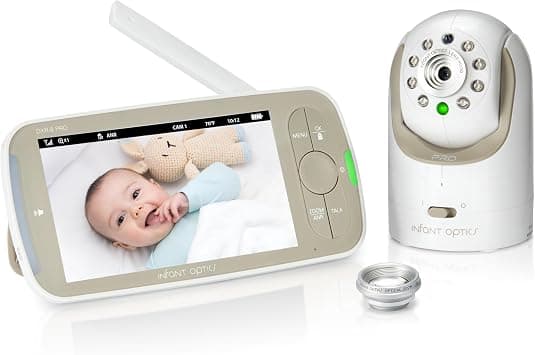
Infant Optics DXR-8 PRO
The premium end of the DECT market, and the only one here with an interchangeable lens, so a wide-angle or zoom lens can be swapped in as the crib layout changes. Active noise reduction cleans up the audio in a way the cheaper units in this list do not attempt. It costs roughly as much as an entry-level Wi-Fi camera, which is the honest comparison to make before buying it.
We may earn a commission on this link. It never changes the ranking.
- Screen
- 5-inch handheld
- Camera
- 1 included, interchangeable lens
- Connectivity
- DECT, no WiFi
- Extras
- Active Noise Reduction, pan/tilt/zoom
What works
- Interchangeable lens system, so the field of view can change without buying a second camera
- Active Noise Reduction filters HVAC hum and white noise machines out of the audio feed
- Pan, tilt and zoom controlled from the handheld, with no app or account involved
- No WiFi at any point in the chain, which the brand markets explicitly as hack-proof
What to know
- The most expensive DECT unit here, within reach of a base connected camera
- 5-inch handheld screen only, no phone view under any circumstance
- One camera in the box, and a second costs nearly as much as the starter kit
$124.95
Price checked Aug 30, 2026
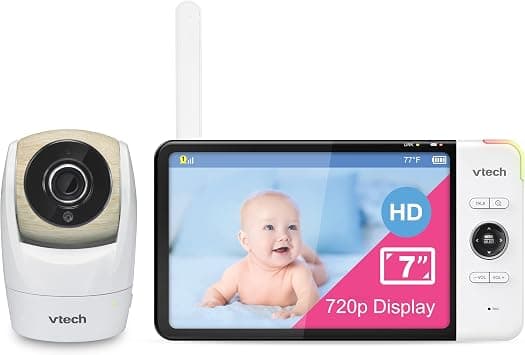
VTech VM919HD
The best-specced unit here for the money, with a 7-inch screen most rivals do not match and a 1000-foot quoted range, which in a real house with walls and floors between camera and handheld translates to a comfortable margin rather than a number you will ever actually hit outdoors. VTech's own marketing calls out the no-WiFi transmission as a security feature, which is the same argument every DECT brand makes and, on the mechanics of it, correctly.
We may earn a commission on this link. It never changes the ranking.
- Screen
- 7-inch handheld, 720p
- Range
- Up to 1000 ft, quoted
- Battery
- Up to 15 hours
- Connectivity
- DECT, no WiFi, secure transmission
What works
- 7-inch screen is noticeably easier on the eyes at 3am than the 5-inch units in this category
- 1000-foot quoted range, generous for anything short of a genuinely large house
- 15-hour battery life on the handheld, among the longer figures in the class
- 360-degree remote pan and a 110-degree wide lens cover more of the crib without repositioning the camera
What to know
- Bulkier handheld than the smaller-screened competitors, which matters if it travels with you around the house
- No lens interchangeability, so the field of view is fixed at purchase
- Plastic build quality reads as what the price suggests rather than premium
$149.99
Price checked Aug 30, 2026
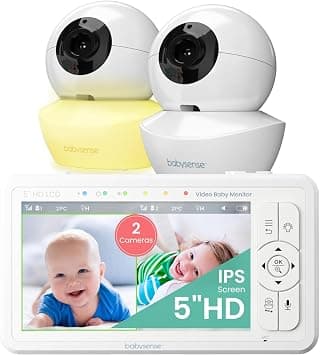
Babysense 5" HD Non-WiFi Split-Screen Monitor
Two cameras out of the box with a split-screen view, which is the answer for twins in separate bassinets or for parents watching a nursery and a toddler's room from one screen instead of buying two separate monitors. Nothing else in this list does two rooms without a second full purchase.
We may earn a commission on this link. It never changes the ranking.
- Screen
- 5-inch handheld, split-screen
- Cameras
- 2 included
- Range
- Up to 1000 ft
- Battery
- 4000mAh
What works
- Two cameras and split-screen viewing included at a price below a single premium camera
- 1000-foot quoted range on both cameras independently
- 4000mAh battery is among the larger capacities in the class
- Night light and lullabies on the camera unit, a genuinely useful extra rather than a gimmick
What to know
- Screen is shared between two feeds, so each individual view is smaller than a single-camera monitor's full-screen picture
- No lens interchangeability or advanced tracking features
- Two-camera systems have more that can go wrong than a one-camera setup, simply by having more hardware
$59.99
Price checked Aug 30, 2026
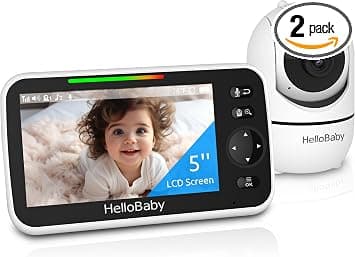
HelloBaby HB6550
The budget entry in the video category, and the right buy for a parent who wants to see the crib but does not want to spend on the lens quality and battery life the more expensive units above are charging for. A 5-inch screen and pan-tilt-zoom at this price is the value case for the whole DECT category, and the trade is a less refined night image than the Infant Optics or VTech units.
We may earn a commission on this link. It never changes the ranking.
- Screen
- 5-inch handheld
- Battery
- Up to 30 hours quoted
- Range
- Up to 1000 ft
- Connectivity
- DECT-class, no WiFi
What works
- Lowest price of any video monitor in this list by a wide margin
- 5-inch screen with remote pan, tilt and zoom, unusual at this price point
- 30-hour quoted battery life on the handheld, longer than the pricier competitors claim
- 1000-foot quoted range keeps pace with the premium units on paper
What to know
- Night vision and color reproduction are visibly a step behind the Infant Optics and VTech units
- Build quality and app-free setup instructions are thinner than the established brands
- VOX (voice-activation) mode, if used to save battery, adds a brief lag before the screen wakes on sound
$23.95
Price checked Aug 30, 2026
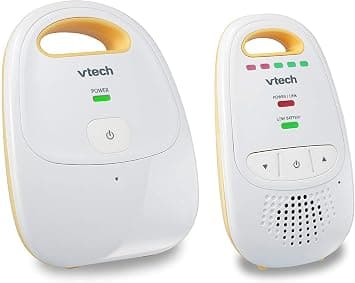
VTech DM111 Audio Baby Monitor
No screen, no video, just a clean DECT 6.0 audio link and a five-level sound indicator so you can gauge volume without staring at a light. For a family who has decided a camera view is not something they want, this is the entire category distilled to its cheapest and simplest form, and DECT 6.0 audio monitors have been a stable, well-reviewed product line for over a decade.
We may earn a commission on this link. It never changes the ranking.
- Type
- Audio only
- Connectivity
- DECT 6.0, no WiFi
- Battery
- Up to 8 hours
- Range
- Up to 1000 ft, quoted
What works
- Cheapest monitor in this entire roundup by a large margin
- DECT 6.0 gives a clean, encrypted audio link with no WiFi or app involved at any point
- Belt clip lets the parent unit travel around the house rather than sitting on one nightstand
- 8-hour battery life is modest but the unit also runs on the included adapter
What to know
- Audio only. No picture, so a rustle or a cough has to be interpreted rather than seen
- 5-level sound indicator is a rough proxy for what is actually happening in the room
- No temperature reading or extra features of any kind, by design
The comparison, in one table
| Monitor | Price | Type | Screen | Quoted range |
|---|---|---|---|---|
| Infant Optics DXR-8 PRO | $199.99 | Video, interchangeable lens | 5-inch | Not published by cameras |
| VTech VM919HD | $124.95 | Video | 7-inch | 1000 ft |
| Babysense 5" Split-Screen | $149.99 | Video, 2 cameras | 5-inch split | 1000 ft |
| HelloBaby HB6550 | $59.99 | Video | 5-inch | 1000 ft |
| VTech DM111 | $23.95 | Audio only | None | 1000 ft |
Who each one is wrong for
The Infant Optics DXR-8 PRO is wrong for a tight budget, because it costs nearly what an entry-level connected camera does and gives up the app, the recording and the multi-camera options that camera would offer. It is right for the family who has already decided against Wi-Fi on principle or on house layout, and wants the best picture available within that decision.
The VTech VM919HD is wrong for anyone who wants a compact handheld that travels easily, because the 7-inch screen is the largest and least portable in this group. It is right for a nightstand setup where the screen never needs to leave the bedroom and a bigger picture matters more than a smaller unit.
The Babysense split-screen is wrong for a single-child household, where a second camera you are not using is dead weight in the box. It is right, and arguably the only sensible pick here, for twins or for a toddler and a newborn in separate rooms.
The HelloBaby HB6550 is wrong for a parent who has read reviews of the premium units and wants that exact image quality at a third of the price, because it is not that. It is right for anyone who wants a real picture of the crib without spending on features they will not use.
The VTech DM111 is wrong for anyone whose main worry is what the room looks like rather than what it sounds like, since there is no camera at all. It is right for the parent who has used a video monitor before and concluded that sound was the only part they actually checked.
What we would actually buy
For most first-time buyers deciding between a video DECT unit and nothing, the VTech VM919HD is the sensible default: the largest screen, the longest quoted range, and a battery figure that holds up over a full night, all at a price well under the premium options.
For a family that has already decided the camera view matters less than they thought it would, the DM111 at twenty-four dollars answers the actual question people are usually asking a monitor, which is simply whether the room has gone quiet or not.
For twins, or two children in two rooms, the Babysense split-screen is the only pick here built for that job, and buying two single-camera monitors instead would cost more and give you two screens to check instead of one.
Questions people actually ask
Is DECT actually more secure than a WiFi camera?
Yes, in the specific sense that matters. A DECT monitor has no account, no cloud server and nothing broadcasting over the internet, so there is nothing for a remote attacker to reach. The trade is that DECT also has no encryption layer to argue about, because there is no network path in or out of the house to secure in the first place.
Can I check a DECT monitor from my phone?
No. That is the entire trade this category makes. A DECT handheld is the only screen, and if you leave the house or the room the handheld is in, you have no view until you come back to it.
Does DECT interfere with my WiFi router or vice versa?
No. DECT in North America runs on the 1.9GHz band, which the FCC reserved specifically to keep it clear of the 2.4GHz and 5GHz bands WiFi uses. The two systems do not compete for the same airtime.
Will a DECT monitor work if my internet goes down?
Yes, completely, because it was never connected to the internet in the first place. This is the main practical reason families in areas with unreliable broadband choose DECT over a connected camera.
Is an audio-only monitor enough, or do I need video?
It depends on what you actually check for. Owner reports on audio monitors like the DM111 consistently describe checking on sound rather than sight, meaning a video screen sat unused for most families who already own one. If you have never owned either, a budget video unit like the HelloBaby answers the question for less than the premium picks cost.
Where this sits in the rest of the kit
The full trade-off between this category and a connected camera, room by room and failure by failure, is in Wi-Fi versus DECT baby monitors. If a Wi-Fi camera is still the plan and the nursery is the problem, monitor range in a house with thick walls covers the fixes before you spend on either kind of monitor. The connected side of the market, and whether a monitor should track breathing at all, are covered in the baby monitor roundup and do breathing monitors reduce SIDS risk. None of these devices makes a sleep surface safer on its own, which is the argument in the cribs and bassinets guide, and the rest of the room lives under Nursery Essentials.
Sources
As an Amazon Associate we earn from qualifying purchases. We earn a commission on some links, at no extra cost to you. It never changes which products we recommend or the order they appear in. Full disclosure

Who wrote this
Writer, standards and the recall record
Dan Whitfield writes the standards side of BabyGearSearch: what a certification actually covers, what the CPSC recall database says about a brand, and what the one-star reviews agree on six months in. He is not a clinician and does not write as one. His job is to read the standard rather than the marketing page, quote the real number, and name the limit the packaging skipped.
More from DanThe standard
How this guide was built
- Manufacturer specification sheets and warranty terms, read in full rather than summarised from a listing.
- The federal safety standard the product is certified to, plus anything NHTSA, the AAP or the CPSC has published on it.
- Owner reports at volume, including the one-star reviews, which is where failure modes live.
- Every price checked against the live listing on the date printed beside it.